
A Reading on the Health of the Stock Market Today
September 4, 2026
To Inform:
Members of The Joseph Group’s Investment Strategy Team had the privilege of connecting with the portfolio manager of one of the “Dynamic” funds held in many client portfolios invested in our Harvest strategy. As a reminder, Dynamic funds are ones in which, to borrow a phrase from Chief Wealth Planning Officer Todd Walter, we’re “betting on the jockey.” This jockey has long managed an asset allocation strategy that seeks to balance what I like to call the “weight of the evidence” in markets to determine how the fund should be positioned.
A common bias that affects fund managers with an approach that considers market valuations is the idea that in periods where the market is “expensive” there is no justification for high valuations and to consider information that might suggest otherwise is not worth their time. This can lead to sitting out or being underweight in stocks during lengthy market advances. This manager’s process differs in that they look at four categories of data – valuations, economic data, sentiment data, and market technicals – to determine their allocation to stocks and bonds. By including multiple indicators and balancing the weight of the evidence, the team’s discipline helps protect them against some of the biases all investors are subject to.
In our call, the portfolio manager highlighted how today some of their signals are radically different in what they are indicating about the stock market. The manager highlighted the fact that the team’s valuation work leads them to believe the market is somewhat expensive, but it was also noted that the earnings growth seen in markets recently is a bit of a rarity. The chart below shows the most recently reported earnings for S&P 500 stocks. Second quarter earnings for the S&P 500 rose nearly 50% over the same quarter a year ago, something not really seen in markets outside of a post-recession recovery.
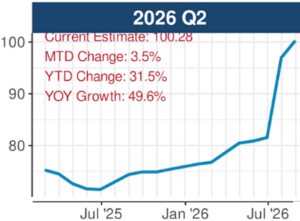
Source: The Leuthold Group
Despite these bumper crop earnings numbers, the portfolio manager is still cautious on valuations because they question how long the market can generate such impressive earnings growth. As a result, their readings on valuation are a liability, or a detracting indicator for adding stock market exposure.
On the other side of the ledger sits the technical readings the portfolio manager follows, the vast majority of which suggest they should be adding stock market exposure. Performance in August in small and mid cap stocks, as well as in financials and cyclical sectors (consumer discretionary, industrials, and materials companies) all point to a broader market advance and suggest that the conditions in which one should be wary are not present. The spaghetti chart below shows the performance of several of the “bellwether” indexes the team tracks to ascertain the technical strength of the market. Typically, at a market top rarely are the majority of these indexes showing the kind of concerted strength they’re showing today.
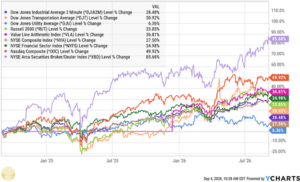
Source: YCharts
After the call we as a team discussed the value of a manager like this in client portfolios, primarily because we think about the world in a very similar way. Our philosophy through time in our approach to markets has been to be realistic but lean towards the positive. There’s quite a bit to be positive about in markets today (market technicals) but also things to be realistic about (valuations). This approach towards markets is one that we think has the potential to navigate the ups and downs in markets with better odds for success than a more emotional, less process-driven approach. Finding a jockey that agrees is certainly helpful in constructing client portfolios that seek risk-managed growth as their goal.

Written by Alex Durbin, CFA, Partner and Chief Investment Officer