
60/40 is an Allocation, Not an Objective!
September 23, 2026
To Inform:
The “60/40 portfolio” is a term referring to an investment strategy that allocates 60% to stocks and 40% to bonds. The term is considered a starting point for a “balanced” portfolio because the stock portion is intended to drive long term growth while the bond portion is supposed to provide stability, income, and diversification benefits.
Team members at The Joseph Group know talking about “60/40 portfolios” is one of my biggest pet peeves. When someone mentions “60/40,” I get a look on my face and sometime twitch a bit.
I feel even many professional investors and advisors sometimes confuse “allocations” with objectives. A “60/40 portfolio” is an allocation, not an objective! Earlier in my career, I worked for a bank trust department and internally you would hear “what’s this client’s objective?” The answer would be “this client’s objective is an 80, or a 60, or a 35….” What they were referring to is the percentage of stocks targeted to be in the client’s portfolio based on their risk tolerance (80% stocks = aggressive, 60% stocks = moderate, etc.). I got annoyed because clients don’t necessarily care how much they have in stocks – they care whether they are able to retire, or send their kids to college, or buy a house…those are true objectives!
 To give you an idea how much the whole idea of calling “60/40” an objective bothers me, here is a picture of my favorite tie. We don’t necessarily wear suits and ties as much as we used to, but this tie has pictures of former Fed Chairman Jerome Powell taking a lighter to a “60/40” allocation graph. It probably takes a true investment nerd to appreciate this tie, but I love it.
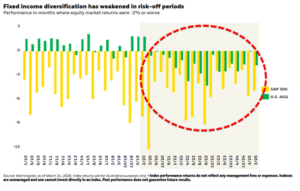
So, let’s get practical. One of the reasons I distain the “60/40” concept is that bonds sometimes provide stability and diversification, but sometimes they don’t. TJG Chief Investment Officer, Alex Durbin, recently showed the chart below to our advisors. The chart goes back to the beginning of 2010 and shows months with declines greater than 2% in the S&P 500 (yellow bars). The chart then shows the performance of bonds in those same months (green bars). As you can see, from 2010 – 2020, the green bars largely went up as the yellow went down, meaning bonds provided some diversification and protection from falling stock markets. However, from 2020 (post-COVID) to today, bonds have declined at the same time stocks have. Over the last six years, in a big picture environment of rising interest rates and rising inflation, investors haven’t been getting much diversification benefit from bonds at all!
Source: iShares/Morningstar
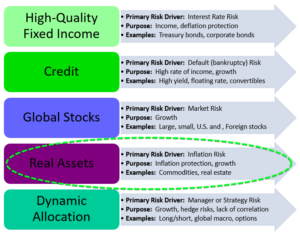
One of the many things we feel makes The Joseph Group different from other advisory firms is our approach to asset classes. When we show clients a pie chart of their portfolio allocation, we don’t just divide the world up into stocks and bonds – we divide it into five different asset classes, each with a different “Primary Risk Driver” which makes that asset class go up and down.
Source: TJG Global Investment Research
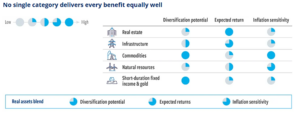
One of the asset classes we use outside of mainstream stocks and bonds is Real Assets. Real Assets include Real Estate Investment Trusts (think warehouses, nursing homes, and data centers), Commodities (think oil, copper, wheat), Infrastructure (think cell towers, solar fields, and railroads), and natural resource stocks (think mining companies and oil refiners).

Source: Cohen and Steers
Real Assets historically tend to move higher as inflation moves higher and can provide diversification benefits through a different pattern of risk and reward compared to other asset classes.
Source: Cohen and Steers
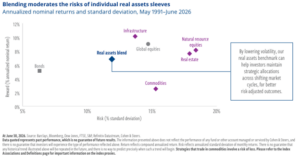
Within the Real Assets sleeve of diversified portfolios at The Joseph Group, we seek to combine real estate, infrastructure, natural resources, and commodities to put together a “real assets blend” which in turn has historical risk/reward comparable to a mix of stocks and bonds, but most important can behave differently, particularly in periods of higher inflation.
Source: Cohen and Steers
In many of our internal meetings at The Joseph Group, we talk about the importance of aligning our clients’ wealth with the objectives those clients are trying to achieve. To make that happen, we seek to start with truly understanding those objectives, then we look to apply wider set of tools (asset classes) to give portfolios the best chance to succeed regardless of what may be happening in markets.
If you get into a nerdy investment conversation and someone starts talking about a “60/40 portfolio,” ask them what that portfolio is seeking to accomplish.

Written by Travis Upton, Partner and Chief Executive Officer