
A New Day at the U.S. Federal Reserve
June 18, 2026
To Inform:
Wednesday marked a new day at the U.S. Federal Reserve. It was the conclusion of new Federal Reserve Chairman Kevin Warsh’s first Federal Open Market Committee meeting. A few things came out of this week’s meeting. To be precise, these things were the Committee’s decision to leave rates alone, the issuance of a new policy statement, and a release of the Committee’s “Summary of Economic Projections.” The market reaction to these three conclusions of this month’s FOMC meeting was all over the place on Wednesday, and perhaps a little more violent than I think was warranted.
It was widely expected that the Committee would leave the federal funds rate where it was, currently at 3.50% to 3.75%. What wasn’t expected was the change to the Committee’s policy statement. What was a 360-word missive in March was just a 130-word statement this month. One of the notable exclusions was cutting from the March statement a nod to the risks to both sides of the Fed’s mandate (full employment and price stability). In other words, in their March statement, the Committee felt that if full employment was at risk, further rate cuts would be warranted. On the other hand, if inflation began to rise, hikes would be warranted. This month, the statement didn’t nod to the sort of downside risks that would warrant further rate cuts. Instead, they stated that job gains have “kept pace” and that “economic activity is expanding.” They noted that inflation has remained elevated relative to their 2% goal, and that the Committee “will deliver price stability.”
The final bit of information market participants had to sort through was the release of the Committee’s economic projections. These projections showed a cut to this year’s forecast for GDP growth from 2.4% in March to 2.2%. At the same time, the Fed predicts that unemployment will average 4.3% this year, a slight improvement from March. Finally, their expectations for “Core” PCE inflation (think everything except food and energy) moved significantly higher to 3.3% from 2.7% in March.

Source: U.S. Federal Reserve
The market’s response to these changes were most impactful to the U.S. 2-year treasury yield, a good predictor of shorter-term interest rates. The rate on this bond rose from around 4.05% the prior day to nearly 4.20% Wednesday afternoon. This may not sound like a lot, but that is a huge move in one day for short term rates. Stocks sold off by about 1% in the U.S. as well. This was the market basically saying, “we think the Fed very well could hike rates.” The Committee said as much as well, with 9 of 18 members projecting the Fed would need to increase rates this year.
Was the Fed, and by extension, the market, right in their assessment of the economic landscape? My instinct is to say no. At the end of the day, the market’s conclusion to the FOMC meeting was that inflation is a big problem and the Fed is probably going to have to hike rates. I disagree with both notions. To hike rates, we have to agree that inflation is more than just a transitory problem. The graph below shows inflation over the past decade. When the Fed began hiking rates in 2022 inflation was a hydra-like monster driven by higher energy, food, goods, and housing prices. An energy shock combined with the post-COVID reopening and demand surge for housing and rent sent inflation to levels nearing an annualized 10% rate. In other words, not transitory. Today, goods price inflation is a relative non-issue while housing prices and apartment rents remain stable. The real drivers of today’s rise in inflation are energy prices, something that could quickly reverse if peace with Iran holds.
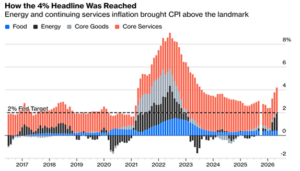
Source: JPMorgan Asset Management
While it is indeed a new day at the U.S. Federal Reserve, some of the old mistakes seem to continue being made. The FOMC is notoriously bad at making forecasts, something even the new Fed Chairman himself noted in yesterday’s press conference. If that is the case, I would submit that instead of watching the Fed, we follow the economic data itself to form our views. If such advice is good enough for Chairman Warsh, I think it’s good enough for the market.

Written by Alex Durbin, CFA, Chief Investment Officer