
A Recap of TJG’s September Portfolios & Pints Event
September 18, 2026
To Inform:
The Joseph Group had the privilege of hosting a large group of friends and clients at our annual Oktoberfest-themed “Portfolios and Pints” this week. As is the annual tradition, I and The Joseph Group’s CEO Travis Upton pulled questions from a hat submitted by our clients over the course of the last several weeks. One of the reasons that makes this event such a great time is the fact that we never quite know what sort of questions we’re going to receive. While one cheeky question focused on the fairness (or lack thereof) of Ohio State’s drop in the polls after a road loss at Texas, we had a host of questions that cut to the quick of what’s happening in markets.
One question was, and I’ll quote it directly, “How are you positioning for the simultaneous possibility of a soft landing, hard landing, no landing, stagflation, disinflation, an AI bubble, an AI productivity boom, a dollar crisis, a melt-up—or are you just quietly hoping nobody asks you what you’re doing? Please come prepared. I will ask follow-up questions.”
That’s a doozy! In essence, I think the questioner was asking how we are preparing clients and portfolios for the range of scenarios that could present themselves in markets with the known risks of AI, inflation, geopolitical stress, and a host of other factors. My answer was not a forecast of which of the above scenarios was most likely, but how our different, objectives-based strategies might handle such a situation.
I’ll start with the “hard landing” scenario. A hard landing in market-speak means a recession. How do client portfolios handle such a scenario? My first thought in hearing this question is our Provision strategy, a portfolio designed for clients who are seeking to generate income to sustain their lifestyle and mitigate the ups and downs of the markets in the process. One way we structure this portfolio to help deliver on this objective is by using high-quality bonds.
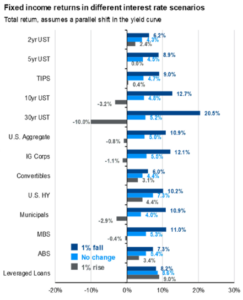
The chart below is a messy looking one, but the message it attempts to share is simply, “what happens to bond prices if interest rates go down 1%, are flat, or go up 1%?” In a hard landing it is highly likely that interest rates will fall. If the economy were to enter a recession and interest rates did indeed fall by 1%, the bond portion of the Provision portfolio would likely rhyme with the performance of the U.S. Aggregate Bond Index. In that event, based on the mathematical relationship between interest rates and bond prices, the total return in this index would be around 10-11%. For a portfolio designed to generate income and protect clients from market downside, we think this is an attractive outcome.
Source: JPMorgan Asset Management
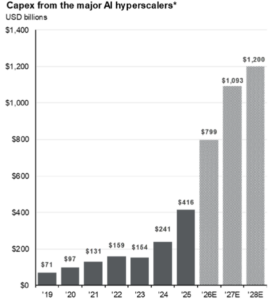
On the flip side, if we were to experience a “no landing” scenario where the economy keeps humming, perhaps as a result of an AI productivity boom, then portfolios are positioned to benefit from that as well. One interesting thing we noted in our presentation was the sheer size of the investment pouring into the AI space. A small handful of companies alone are estimated to invest close to $800 billion in 2026 with forecasts reaching over $1.2 trillion by 2028. If these forecasts prove to be even directionally right, I think of the Home Grown strategy of individual stocks we have the privilege of managing on behalf of clients. This portfolio has some companies that are considered to be direct beneficiaries of the buildout in AI, but also some companies that are a little less well-known but critical in the development of the infrastructure around AI.
Source: JPMorgan Asset Management
In sum, our job is not to make a bold bet preparing for one of the above scenarios to pan out. Few attempt that and even fewer are successful. Our job is to create what Travis Upton likes to call “anti-fragile” portfolios that can endure a range of scenarios and give our clients the best opportunity to meet their financial objectives. An old boss of mine, the CIO of a very strong public pension, once told me something to the effect that investing is simply a game of probabilities. If you play the game well and understand the probabilities and what asset classes can thrive in what scenarios, your long-term objectives can become a reality.

Written by Alex Durbin, CFA, Partner and Chief Investment Officer