
Are Markets Behaving Irrationally?
May 8, 2026
To Inform:
There are a few sayings in the investment world that stick in your mind and are useful in different seasons. One such saying I’m thinking of right now is John Maynard Keynes’ oft-quoted “Markets can remain irrational longer than you can remain solvent.” Now, the use of this quote requires an answer to two questions. One simply being “what does it mean?” The other being “are you saying markets are irrational right now?”
The point of Keynes’ quote was to say that markets can behave in ways that a rational person finds hard to comprehend and for a lot longer than they would expect. The adage is often used to describe the risks of betting against a stock through short selling. The short seller might be right in their thinking that the stock will go down, but the market may disagree and may disagree for long enough that the short seller is no longer solvent.
Through this morning and barring any late day theatrics, the S&P 500 is up over 7% year-to-date and is trading at all-time highs. This, in spite of the fact that oil prices are near $100 a barrel, interest rates are meaningfully higher than they were just two months ago, and we still have an unresolved conflict to deal with in the Middle East. So, is the market irrational today?
We were asked a similar question at the end of last year about the U.S. stock market. Our answer then was that stocks weren’t cheap, but that corporate fundamentals are undeniably strong. So far into 2026, that remains the case. One of my favorite charts during quarterly earnings season is the one compiled by Strategas, a research partner we’ve long followed. They show the evolution in sales and earnings growth expectations by analysts on Wall Street from the beginning of the first quarter to the end of the first quarter against what companies have reported. Every single S&P 500 sector saw reported sales growth better than expected at the beginning of the quarter and even at the end of the quarter, when analysts tend to revise their data after having a better sense of how the quarter went. Earnings growth was better in eight of 11 sectors over the same time.
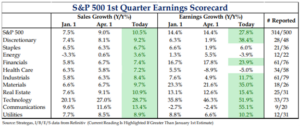
Source: Strategas
Looking at this table, it is hard to say the market is behaving irrationally. In fact, the price-to-earnings multiple on the S&P 500 has declined since the beginning of the year as earnings growth has surprised to the upside.
Another way to measure how rational (or irrational) the market is being is to look at various sentiment indicators. CNN compiles their “Fear and Greed” Index that is a composite of a variety of sentiment indicators. Right now, CNN’s index is tilted in the “greed” direction but remains far from “extreme greed.”
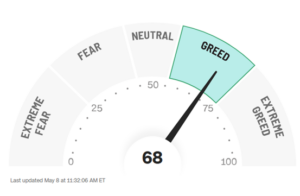
Source: CNN
Lest you think me to be a permabull, there are some areas of the market that seem perhaps a little extended. While it looks like AI is and will be a massively transformative technology, I don’t think every company currently operating in that space ends up a winner. The market, however, is behaving otherwise. The average semiconductor stock (think memory chips, graphics processing chips (GPUs) and the like) is 61% above its 200-day moving average, with some well over 100%. That’s quite an air pocket if these companies encounter any turbulence.
So, while I think Keynes’ adage is one we’d do well to remember, I don’t think it is entirely apt at this moment in time. While there are some areas of the market that may be out over their skis, corporate profits are strong and investor sentiment is not yet “irrationally exuberant” (that’s a phrase for another WealthNotes). If and when we see otherwise, we’ll be sure to report it!

Written by Alex Durbin, CFA, Chief Investment Officer