
Insights From the Road – Thematic Investing
June 26, 2026
To Inform:
This week, I had the opportunity to travel to Santa Fe, New Mexico to a conference put on by VanEck, a well-known investment firm. Fund managers discussed investment insights related to major themes driving the economy – themes such as AI, semiconductors, power generation, data centers, and natural resources.

Source: Travis Upton
In The Joseph Group’s Investment Strategy Team meetings, we often talk about differentiating between “investment themes” and “investment fads.” Fads are short-lived and chasing them can often lead to losing money. Themes are investible ideas which are more long-lasting and reflect the ideas which are taking the economy from where it is today to where it will be in the future. One of the presentations at the conference laid out a simple three-part framework for viewing the current economic environment.
The Future Is Digital
Artificial intelligence is changing our world and although we may all have thoughts on the direction AI is taking us, there are likely impacts we will only understand with time. From an investment perspective, “investing in AI” isn’t just a solitary concept – it’s thinking about different ways AI is touching our world. Investing in AI may include owning stocks in:
- vertically integrated companies who are using AI to support their core operations such as major online retailers or space-oriented companies;
- hardware companies who are designing or manufacturing computational and memory chips that are making AI happen;
- software companies who are programming the language models used by businesses and individuals who are incorporating AI into their operations or their lives.
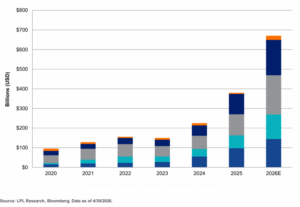
The chart below shows the huge growth in capital expenditures by big “hyperscaler” technology companies (over $700 billion in 2026), which is largely focused on AI infrastructure.
Source: VanEck
It is also interesting to think about industries whose cost structure may change for the better due to AI. A potential example here is health care. The research and computational power needed to drive new solutions within the biotechnology and pharmaceutical industries is huge and AI could drive down costs and accelerate opportunities.
Bottlenecks Are Physical
One of my notes from the conference says to “think about the whole data center supply chain – from the grid to the rack.”
The “grid” refers to the power grid and the fact data shows sustained growth in the demand for power. We are seeing private deals where technology companies are signing direct “power purchase agreements” with utility companies to secure access to electricity. We are also seeing huge capital expenditures to upgrade infrastructure and to areas such as nuclear power as the energy and utility industries try to find creative ways to catch up with demand.
Much of this power is going to “the rack” – the data centers where the servers powering, processing, and storing AI information is happening. Building a data center requires natural resources such as concrete, steel, copper, and aluminum. It also requires land and opportunities for real estate investors to benefit from long-term leases signed by “hyperscaler” technology companies.

Source: VanEck
Within the diversified portfolios The Joseph Group has the privilege of managing for clients, we include a “Real Asset” sleeve which contains exposure to natural resources, commodities, global infrastructure, and real estate. We believe this Real Asset sleeve is going to benefit from rising demand and is an important way to address client objectives as we look at the economy of the future.
The Cost is Monetary
This week we have seen a bit of market volatility as a huge consumer technology company said they would need to raise prices due to the soaring input costs of memory chips.
As economic data shows continued inflation pressures, we are also seeing shifting expectations for interest rates. Earlier this year, the market was expecting the Fed to cut rates. Today, based on the market for FedFunds futures, the market is only pricing in 36.6% odds short term interest rates will be unchanged at the September 16th Fed meeting, with 48.6% odds of one hike and 14.8% odds of two hikes.

Source: CME FedWatch
When we look at the themes driving changes in the global economy through an investment lens, we must acknowledge “what got us here may not be what gets us there.” The Joseph Group’s investment process is grounded in achieving objectives for clients rather than trying to fit in with a specific stock/bond allocation. We believe this objectives-based framework makes us well suited to pursue opportunities and achieve long-term peace of mind for clients regardless of what’s happening in the headlines.

Written by Travis Upton, Partner and Chief Executive Officer