
Investing for a Changing World
February 19, 2026
To Inform:
American political scientist Francis Fukuyama wrote a book in 1992 titled The End of History and the Last Man. In his book Fukuyama posited that Western-style democracy was the final form of government for all nations and that the world would soon see more cooperation between nations, freer trade, and less war. Geopolitical events of the last few years have put an explanation point on the flaws in this thesis.
Strategas, a research firm we have long subscribed to and respected, describes this era we live in – one where history has not ended – as one of “polyfragility.” This is a ten dollar way of saying, “there are a lot of risks out there!” In their recent note explaining these views Strategas said that investing in such a world requires a “new – and evolving – playbook.”
A major change we’re witnessing today is the slow reversal away from a decades long project of globalization. Strategas mentions that in a world where global trade is increasing and trade barriers are being eliminated, companies and countries position themselves for “optimization.” In a world of less global trade and more conflict between countries optimization gets replaced with redundancy. This, naturally, shakes up financial markets.
An interesting effect of this sort of changing world has been the impact on markets outside the US. Many developed countries outside the US have grown quite complacent in recent years with things like military spending and economic competitiveness. Capital that might otherwise have been invested in these countries instead poured into the United States. This was good for owners of US stocks and bonds, but not so good for people who owned stocks and bonds outside the US. As this has begun to change and places like Japan and Europe seek to revitalize their economies, we’ve seen their long moribund markets begin to wake up. Take, for example, the performance of non-US stocks over the first 31 trading days of 2026. Non-US stocks have outperformed the S&P 500 by nearly 8%, the best such showing in over 30 years.
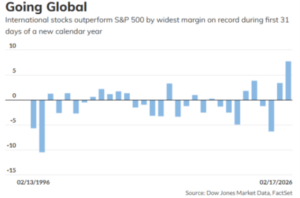
Source: Fortune
This era of “polyfragility” has other implications, notably in the area of “real assets”. Real assets are most easily described as things you can touch. One mutual fund manager we recently had a conversation with termed the importance of real assets as “atoms vs bits.” A response to all of this has been a solid run in the stocks of natural resource companies. Since the end of 2024, an index of natural resource stocks (think energy companies, agricultural companies, mining companies) is up over 46%, compared to the S&P 500 being up just 16%.

Source: Morningstar
The upshot in all of this is that history has not ended, and that diversified investment portfolios that haven’t made that assumption are geared for the kind of world that Strategas has described as “polyfragile.” Though the risks are perhaps different than they are in a more stable world, it doesn’t mean they can’t be considered or that investors can’t position themselves to benefit from this changed world. At the Joseph Group, we think intentionally about the sorts of asset classes that might benefit from a changing world and seek to gain exposure to them in client accounts we have the privilege of managing. In this way we hope to create portfolios and ultimately financial plans that are “antifragile.”

Written by Alex Durbin, CFA, Partner & Chief Investment Officer