
Investing in Times of Uncertainty
March 6, 2026
To Inform:
This week, TJG’s Senior Investment Analyst Jerry Brown and I had the good fortune to host Kay Herr, JP Morgan’s U.S. Chief Investment Officer for their Global Fixed Income, Currency, and Commodities team. Put another way, she’s a big deal in the bond world. The neat thing about bond investors is they tend to be more focused on the macroeconomic (think big picture) environment than people in other disciplines within financial markets. Conversations with these folks tend to be fruitful in times where there is a good deal of uncertainty and upheaval in the global macro environment.
In our discussion with Kay, she revealed to us that the standard playbook for how a bond trader would position for a geopolitical event as seismic as what is happening with Iran would be to buy treasury bonds. Typically, the interest rate response to anything that smacks of war would be for interest rates to fall as investors seek the safety of government bonds and fears of an economic slowdown mount. The graph below shows the rate on the U.S. 10 Year Treasury Bond since the beginning of 2026. After climbing to as high as 4.31% in January, rates fell to 3.96% on the eve of the Iran conflict. The bond investor who bought before the bombs started falling lost money, as yields have risen since the conflict began.
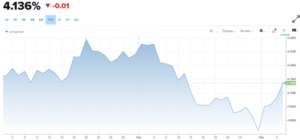
Source: CNBC
This highlights an important principle to us: what investors often think will happen in response to a major event often ends up not being the case. It’s hard to say why this is. In this scenario, perhaps the decline in U.S. Treasury Bond yields that began in February was the market adjusting to increased hawkishness on Iran. Perhaps the recovery in yields is the market seeing through the event and discounting a resolution that ends up being sooner rather than later.
What is interesting is that this pattern of behavior is common in the aftermath of geopolitical events. The initial reaction to the event is often muted and markets have resolved higher in the year after the event. There are outliers, of course. One major event that, oddly enough, did not experience a major selloff in the immediate aftermath was the Yom Kippur War in 1973. The market initially handled this well, falling less than 1% in the weeks after that conflict began. This same event saw the S&P 500 down more than 40% in the 12 months after it began.
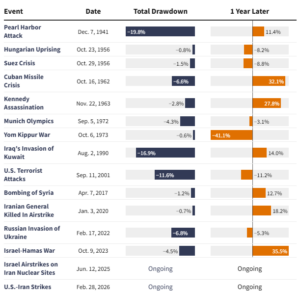
Source: Investopedia
We think it is far too early to make bold predictions as to how the strikes on Iran proceed. If history is a useful guide, our bias is to not overreact. Investors present during the conflicts of the 1970s may naturally find some parallels with today’s conflict, but there are also some key differences. The biggest difference we see is that nearly every government in the Middle East is aligned against Iran. Saudi Arabia has been vocal about their distaste for the Iranian Regime. The United Arab Emirates is exploring the idea of freezing Iranian assets, according to an article published last night by the Wall Street Journal. In the 1970s, nearly every Arab nation was aligned against the United States and Israel.
The biggest takeaway from our conversation with Kay was to filter out the noise and the urgency to act in periods of uncertainty. The temptation to do so is strong, but the historical record is mixed at best. A better approach, we think, is to prepare for these events before they happen by constructing a financial plan that is durable and can navigate periods of “bad weather.” At The Joseph Group this starts with the Storyboard, which is tailored to every individual client and continues through the use of objectives-based investment portfolios. This isn’t the first time this approach has been tested, and it won’t be the last. We’re confident our approach here at The Joseph Group is best suited to helping the clients we have the privilege of serving to meet their financial goals.

Written by Alex Durbin, CFA, Chief Investment Officer