
Markets and the “Wall of Worry”
July 10, 2026
To Inform:
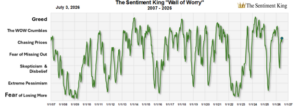
The “Wall of Worry” is a mythical structure on Wall Street whose bricks are comprised of all the fears that investors are dealing with at a point in time. The phrase first came into use in the 1950s, and it is now often said that “markets climb the wall of worry.” This wall always exists, but at times it can be a little taller and at other times a bit shorter. Financial blogger Michael McDonald has written about different stages of the Wall of Worry and uses sentiment data to essentially measure the height of the wall. The output of McDonald’s data is shown in the graph below. When the line is near the bottom you could say the wall is tall. There are a lot of things investors are worried about. When it’s near the top you could say it’s short and investors have no fear. So, where is the wall today and what are investors worried about? Let’s dig in.
Source: Michael McDonald/Sentiment King
If I had to pick three things I’d say the things that worry investors the most are Iran, inflation, and AI. We saw the Iran bugaboo crawl out of the woodwork earlier this week with what appears to be the crumbling of the heralded “Memorandum of Understanding” between the U.S. and Iran that looked to promise a cease fire and, ultimately, a resolution of the conflict. With Iran, though, it’s possible the fears are overblown. Oil prices are up a mere three dollars this week after Iranian missiles hit an oil tanker in the Strait of Hormuz. The pressure on Iran remains immense, and their ability to project power in the region has been seriously degraded since the beginning of the conflict. While this “brick” in the wall remains, we think it is much smaller than it was several months ago.
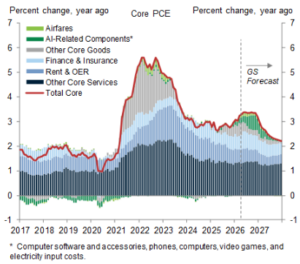
Inflation’s role in the “Wall of Worry” is a little bit more difficult to handicap. While the impacts of higher oil prices are largely gone, “core inflation” remaining above the Fed’s target of 2% is still an issue with the Federal Reserve and has a major impact on consumer confidence. The sources of inflation can be wide-ranging so let’s unpack them. Goldman Sachs compiles data on the inflation readings compiled by the U.S. Bureau of Economic Analysis. Core PCE, the Fed’s preferred measure of inflation, strips out food and energy prices given their volatility. As the chart below shows, the inflation spike in 2022 had many sources: shelter, core goods, and other services. Today’s milder spike is coming a little bit from “other core goods,” finance and insurance costs (think auto insurance), and “AI-Related Components.” While AI-related components were once a source of disinflation (prior to 2022), they are now responsible for a slight uptick. This brick is one worth watching, but I don’t think markets will have a hard time clearing it.
Source: Goldman Sachs
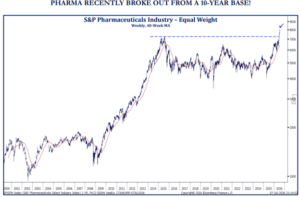
Finally, the “AI-related” fears in markets are perhaps the last major brick in today’s Wall of Worry. This brick can take on all sorts of shapes. For some, it is the fear of what AI will do to the jobs market. For others, it is what AI will do to software companies. For still others it may be fear for what happens to the stock market if the performance of AI-beneficiaries cools off or even reverses. As it relates to the jobs market, the U.S. is still adding jobs and is doing so at a faster pace than in 2025. The impact of AI on software companies has been severe, but earnings here continue to expand while valuations have come down significantly. We’ve seen recently the manifestation of the final fear. AI-related stocks (mostly semiconductors) took a breather in the month of June, with many down 10-20% from their peaks. Instead of throwing the rest of the market off its kilter, we saw capital rotate to other areas of the market that had been left behind. After peaking more than a decade ago, pharmaceutical stocks just logged a new all-time high amid pronounced weakness in AI stocks. Relative weakness in AI-related stocks leading to strength in other areas of the market is one trade I’m happy to make.
Source: Strategas
Markets have and always will climb the Wall of Worry. This uncertainty – today around Iran, inflation, and AI – is why there is a risk premium to owning stocks. Could some of these fears go on to become a bigger deal in markets? It’s always possible. That said, we’re comfortable with the risks in today’s markets and think our objectives-based approach is one way investors can confidently take on the wall in any environment.

Written by Alex Durbin, CFA, Partner and Chief Investment Officer