
Mr. Market and the Conflict in Iran
April 2, 2026
To Inform:
One would think that with ubiquitous internet access and billions of cell phones in service globally that we’d have a very clear picture of what is happening within Iran. One commentator I follow said he thinks the “fog of war” surrounding the conflict with Iran is as great as it has ever been with any conflict over the last two millennia. His belief is that the use of A.I. to share videos and images that are factually dubious has made it very difficult, even for news organizations, to understand what is happening on the ground.
Our view in such an environment is to pay attention to what one of the best journalists in the world is telling us about the conflict. That journalist is Mr. Market. Mr. Market, a moniker for the stock market, but one we’ll expand to cover commodities and bond markets, isn’t perfect. Mr. Market gets things wrong, quite memorably in January and February of 2020. That said, Mr. Market isn’t biased, he quickly reprices asset classes as new information becomes available, allowing us to forgive him for the occasional miss.
So, which areas of the market are we looking to Mr. Market for help assessing the status of the joint U.S./Israeli conflict with Iran? We’re focused on oil prices, interest rates, and gold.
Beginning with oil prices, we saw a meaningful jump in the first week of the conflict, but we’ve been in a tight range since then. Mr. Market is signaling here that despite a hit to short-term supplies; the possibility of a deeper supply shock is still low. What might explain this? It could be the expectation that Iran’s largest trading partners get their ships through Hormuz (we’ve seen evidence of that in recent days) or that the administration succeeds in securing the Straits military through either additional forces or a change in regime in Iran. Until the facts on the ground change, I’m trusting Mr. Market that, at least at this point, we aren’t set to experience a catastrophic price shock.
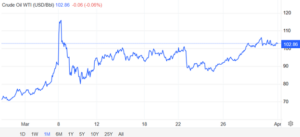
Source: Trading Economics
We think Mr. Market is telling us to look at interest rates to get a sense for the severity, length, and inflationary impact of the conflict. On February 27, the Friday before the conflict began, the rate on the U.S. 10 Year Treasury Bond was 3.96%. After peaking during the day on March 27 at 4.48%, rates have fallen back to around 4.3%. Rates have moved lower on good news (or rumors of good news), while moving higher on bad news since the conflict began. If the days’ recent trend holds, we think Mr. Market is forecasting an end to this conflict sooner rather than later. We believe if rates can stay under 4.5%, stocks can navigate this environment okay. Over the last several years, US stocks have struggled when the U.S. 10 Year rate exceeds 4.5%.
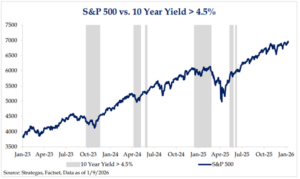
Source: Strategas
Finally, we think movements in the price of gold are another helpful forecasting tool provided by Mr. Market. After running up into the conflict, gold prices have fallen more than 10% since the conflict began. After years of heavy central bank buying, there is a real sense that certain governments who are heavily exposed to high oil prices and goods that depend on free navigation of the Arabian Sea have been liquidating gold. Gold is off its recent lows by a modest amount as rumors of peace talks continue to swirl.
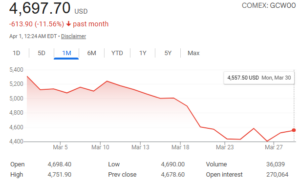
Source: Google
The movement of oil prices, interest rates, and gold over the last few days is, we believe, telling us that the conflict with Iran has reached its zenith and may in fact be de-escalating after highly disruptive strikes on energy infrastructure in prior weeks. In times like this we’ll keep reading the news, but we’ll be reading it with a grain of salt and an eye on what Mr. Market is telling us.

Written by Alex Durbin, CFA, Partner and Chief Investment Officer