
Portfolios At Your Place Q&A
August 20, 2026
To Inform:
Travis Upton, CEO of The Joseph Group, and I had the pleasure of updating clients this week in one of our Portfolios at Your Place Zoom calls. The focus of our conversation was the Harvest portfolio, our objectives-based strategy for investors with long-term, tangible goals. Our conversation centered on the distinct asset classes held within the portfolio, and how current economic and geopolitical happenings are impacting the portfolio itself. Our clients sent in a handful of thoughtful questions beforehand and during the presentation. For this week’s WealthNotes, I thought it might be interesting to take the “mailbag” approach and answer some of those questions.
One of the questions submitted in advance was about the “Buffett Rule.” A decade or so ago, Warren Buffett wrote in his letter to shareholders that, upon his passing, his estate should be invested with 90% in the S&P 500 and 10% in short-term government bonds. Our thoughts on this rule are many. We think Buffett is right in placing his optimism in American markets. We live in an incredibly dynamic country filled with bright people who have a history of innovation and problem solving (see our July 4th Wealthnotes). That said, there are reasons why we think this rule might work well for Buffett but not for everyone.
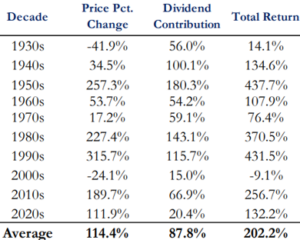
The table below shows the performance of U.S. large company stocks by decade, going back to the 1930s. While the U.S. has had three lengthy bull markets in the last 100 years, these bull markets have been interrupted by decades where stocks don’t do much at all. The most recent was the 2000s, coined the “lost decade” for U.S. stocks. In the 1970s, while stocks posted a positive return, they underperformed inflation, which saw the consumer price index more than double from January of 1970 to December 1979.
Source: Strategas
While we are not forecasting a lost decade or one in which the returns of stocks are dwarfed by inflation, our view is that it makes sense to take an “anti-fragile” approach to portfolio construction. We think the risk posed to Buffett’s estate if he’s wrong is minimal. For someone saving for retirement or relying on their assets to get them through retirement, we think it is prudent to hedge against the “what if” scenario.
We received several questions about interest rates, bonds, and things like digital currencies. With news that the U.S. has now crossed the $40 trillion dollar level in government debt and interest rates remaining stubbornly high, we find these questions salient.
We don’t know how the government debt issue gets solved here in the U.S. (or elsewhere, for that matter). We don’t doubt, however, that the debt is having an impact on interest rates. That said, in the spirit of anti-fragility, we believe our diversified approach to the Harvest portfolio puts clients in the seat they need to be in this environment of government fiscal extravagance.
I recently tuned into a conference call with Meb Faber, an investor with a well-known anti-fragile streak. On this call, Faber talked a little about the government debt issue and simply said that in this environment, “you want to be an owner of assets.” What I take that to mean is that ownership of real assets is a way to provide diversification and a hedge against inflation, something bonds haven’t been doing much of in recent years.
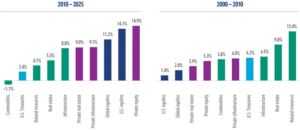
We define real assets at The Joseph Group as commodities, infrastructure, and real estate. The bar charts below highlight the performance of these asset classes over the 15 years from 2010 to 2025 and the 10 years from 2000 to 2010. As you can see, these asset classes didn’t do much in the 2010-2025 period, at least compared to U.S. stocks or private equity. In the 2000s, however, an equal-weighted basket of these asset classes was up just under 10% per year, outperforming traditional stock indexes by a wide margin. We believe the economic environment we’re in is one that argues for the diversification benefits real assets have a history of providing.
Source: Cohen & Steers
Our hope after every investment education event is that attendees walk away feeling more informed than they did coming in. Another hope is that attendees feel confident in our approach to constructing portfolios to solve for their investment objectives. The Harvest portfolio’s multi-asset approach and ability to adapt to a wide range of environments is, we believe, an approach that a patient investor with long-term growth objectives can have confidence in. If you have any questions about this portfolio, send them our way or save them for next month’s “Portfolios and Pints” at the Hofbrauhaus in Grandview where Travis and I will be pulling questions from a hat. We hope to see you there!

Written by Alex Durbin, CFA, Partner and Chief Investment Officer