
Quick Thoughts on Out of This World IPOs
June 12, 2026
To Inform:
An initial public offering, or IPO, refers to the process of where a privately owned company first sells shares of stock to the public. Often, this process is referred to as the company “going public.” Companies typically use IPOs to raise capital for growth, pay down debt, or allow early investors/founders to cash out their shares. Once the IPO is complete, the company shares are typically listed on a public stock exchange.
In the weeks and months ahead, several large companies tied to the space and AI industries are expected to “go public” and have the potential to shift the make up of major stock indexes. While we cannot comment on specific companies, given the headlines in the media, I wanted to share a few thoughts about IPOs.
- Popular IPOs can be almost impossible to get access to prior to the “going public” offering. The number of shares available is limited and the allocation process typically favors large institutions rather than individual investors. In the rare cases investors can receive shares, it is common for them to receive only a fraction of the shares they may request.
- Not all IPOs will be put immediately into major indexes. One of the common “support cases” we have heard about IPOs is that major index funds, such as those which track the S&P 500, will be forced buyers of the stock. Standard and Poor’s, the company behind the S&P 500, requires 12 months of “market seasoning” and positive profitability with no fast-track entry permitted into the index. While some index providers have talked about loosening their rules for popular AI and space-oriented companies, S&P has indicated they will “hold the line.”
- A company may not sell all their shares to the public. Just because a company is going to go public, it does not mean all of its ownership is public. For example, one popular IPO is only planning to float 5% of its outstanding shares, leaving 95% of the company ownership still private.
- Governance and voting structures can vary. Just because a company is public doesn’t mean shareholders have power. The terms of one popular IPO is giving its primary owner a “super voting” structure which is effectively granting the CEO 85% of the voting power. This means no institutional investor, board member, or external stakeholder has the ability to put a check on strategic decisions or have any recourse if priorities shift.
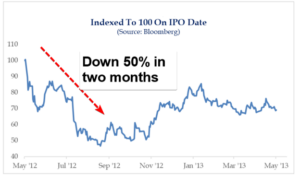
- Lessons from history suggest better buying opportunities may come after the IPO. A little over 10 years ago, I remember the hype around a big social media company going public. Here is a chart of how that company’s performance played out after the IPO. Within 2 months, the stock was down over 50% from the IPO price. The company went on to be a great long-term performer, but the best buying opportunities came after the IPO. I don’t know if the same pattern will happen again with the current popular IPOs, but I do know that while history does not repeat itself, it often rhymes.
There is a lot of excitement in the media about IPOs potentially blasting off in the days and months ahead. As always, we want to make investment decisions based on logic rather than emotion on behalf of our clients.

Written by Travis Upton, Partner and CEO