
The Timex Economy
May 29, 2026
To Inform:
If I surveyed a room of our clients and asked what phrase comes to mind when they hear the word “Timex” it wouldn’t take long before someone called out “takes a licking but keeps on ticking!” In researching old advertisements, I found a commercial from the 1970s that showed a long-haul trucker telling the story of how he dug what looked like a quarter out of the asphalt at a truck stop only to realize it was the time piece of a Timex watch. The trucker put the time piece on a new band and had a perfectly operating wristwatch. In reviewing recent economic data this phrase came to my mind as it appears the U.S. economy has similarly durable characteristics. Despite several “lickings” in the last couple of years, the economy keeps on ticking.
LABOR MARKET
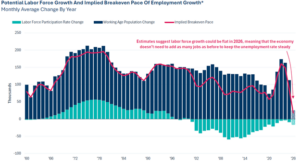
One area of the economy that has held up well despite angst-ridden headlines is the labor market. There’s been a lot of press about the slower pace of jobs growth in the last 18 months, but an interesting development in the labor market shows us that maybe that isn’t as important a factor. The chart below shows the monthly average growth of the labor force since the 1960s. Peak labor force growth occurred in the 1970s as Baby Boomers were entering the labor force and more women were deciding to work outside of home. Then, the economy needed to add around 200,000 jobs a month for unemployment to remain steady. Today, between retiring Baby Boomers and reduced immigration, a slower growing labor force requires far fewer new jobs (some estimate as low as 50,000) a month to keep unemployment steady.
Source: Payden & Rygel
This seems to make sense when we look at weekly jobless claims data consistently in the range of 190,000 to 220,000 over the last year. For context, there wasn’t a single week in the 2000s where weekly jobless claims fell below 250,000. In sum, ours is an economy with low layoffs and nearly full employment. Ticking nicely, indeed.
MANUFACTURING
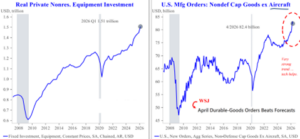
Another part of the economy that has remained ticking despite challenges around tariffs, inflation, and war is in manufacturing and capital equipment spending. Manufacturing PMI data, a monthly reading that measures a host of data points, has recently climbed above 50 (indicating expansion) and has remained there after spending much of the last several years below 50 in contraction.

Source: Strategas
Private investment in equipment and capital goods is also strong, with both measures at all-time highs. The types of investments in these categories cover a range of things including computer equipment, factory machines, engines and power turbines, commercial trucks, office furniture, and all sorts of things in between.
Source: Strategas
CONSUMER SPENDING
Finally, the consumer keeps on ticking, despite the mental toll of lickings from tariffs, inflation, and high gasoline prices. Consumer spending growth, a somewhat volatile figure, remains comfortably positive, tracking at around a 3.5% annual growth rate and well above levels seen in 2024 and most of 2025. This is occurring against a backdrop where household debt service payments as a percentage of disposable personal income is around 11%, well below the 15-16% figure seen in the mid-2000s.

Source: Strategas
This WealthNotes piece could be a lot longer if we wanted to explore additional areas of strength in the economy, but time and space won’t allow. Nevertheless, hopefully this helps shed a little light on the resilience of the U.S. economy and where we’re seeing it. The impact on markets of this resilient, “keeps on ticking” economy was recently noted as we wrapped up earnings reporting season for the 1st quarter – earnings for S&P 500 companies grew by more than 28% year-over-year. While I’m not sure that pace can be maintained, I am sure that you can set your watch to the dynamism and innovation within our economy and the people of this country to “keep on ticking.”

Written by Alex Durbin, CFA, Chief Investment Officer