
TIPS for Your Portfolio
October 16, 2026
To Inform:
Over the last few weeks, a big topic within the Investment Strategy Team meetings at The Joseph Group has been TIPS – Treasury Inflation Protected Securities. Clients holding certain portfolio strategies we have the privilege of managing on their behalf may have noticed trade confirmations recently as we seek to take advantage of a potential opportunity. What are we thinking? Let’s dive in.
What Are TIPS?
Treasury Inflation Protected Securities (TIPS) are bonds issued by the U.S. government, just like normal Treasury bonds. What makes these bonds different is they are specifically designed to hedge against rising consumer prices.
TIPS effectively have two components: an inflation adjustment component and a real rate of interest component. Here is how they work:
- The face value of these bonds (typically $1,000) is pegged to the Consumer Price Index (CPI) and is adjusted upward as CPI rises (that’s the inflation component).
- The Treasury then pays interest on the adjusted face value of the bond (that’s the real rate of interest component), which creates a gradually rising stream of interest payments if inflation continues to rise.
- At maturity, a TIPS investor will receive the original face value of the bond, plus the sum of all inflation adjustments since the bond was issued.
For clarity, let’s look at an example. Assume you invest $1,000 in a new 10-year TIPS bond with a 3% interest rate, meaning investors would expect an interest payment of $30.00. If inflation is 2.5% over the next year, the face value of the bond will be adjusted upward by 2.5% to $1,025. The annual interest payment would then be 3% of $1,025, or $30.75. Assuming inflation continues to rise each year, both the face value of the bond and the interest payment would continue to increase commensurate with the CPI over the life of the bond.
Concept of the “Breakeven Inflation Rate”
Let’s look at one more concept before we get into the practicalities of today.
TIPS are said to offer a “real” rate of return – the actual rate of return of an investment after inflation is considered. On the other hand, regular Treasury bonds are said to offer a “nominal” rate of return, which means the rate of return before inflation is considered (nominal = real + inflation).
Since the interest paid by TIPS strips out inflation and nominal does not, we can look at the difference between the interest rate on a standard nominal U.S. Treasury bond and the real interest rate on a TIPS bond of the same maturity to determine the “breakeven inflation rate.” Here is the formula:
- Nominal Treasury Yield – TIPS Yield = Breakeven Inflation Rate
Applying this formula using 10-year Treasury rates as of 10/16/2026:
- 5.09% (nominal 10-year Treasury yield) – 2.76% (10-year TIPS yield) = 2.33% (breakeven inflation rate)
The breakeven inflation rate is the rate which would make the nominal return of the regular Treasury bond equal to the return of the TIPS bond over the same timeframe. The breakeven rate effectively provides a market-based estimate of what inflation is expected to average, in this case, over the next 10 years.
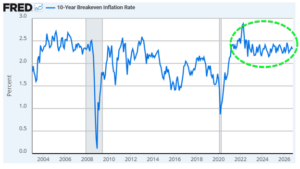
The breakeven inflation rate can vary, but as shown in the chart below, the 10-year breakeven rate has remained remarkably stable despite war and rising oil prices. Since 2022, the breakeven inflation rate has remained between 2.2% and 2.5% (green circle).
Source: Federal Reserve Economic Database
The breakeven inflation rate is an estimate. It implies if actual inflation ends up being:
- higher than the break-even rate, TIPS provide a better return.
- lower than the break-even rate, standard nominal Treasuries provide a better return.
Why Are TIPS Interesting Today?
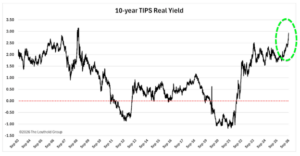
So now that you are all experts in inflation protected bonds, why is The Joseph Group’s investment team interested in TIPS? The chart below shows the 10-year TIPS real yield with data going back to 2003. Here’s the punchline – the real yield on TIPS, at about 3%, is currently close to its highest level in over 23 years.
Source: The Leuthold Group
Yesterday, Alex, Jerry, and I had the opportunity to have a conversation with Tom Tzitzouris, Head of Fixed Income Research for Baird Stategas. According to Tom, “TIPS are currently the most attractive they have been since the global financial crisis in 2008.” Tom went on to say, “buying TIPS today, you have a cheap hedge against inflation rising further. If inflation rises, you are likely going to be glad you own TIPS.”
We talk a lot about managing portfolios to achieve client objectives. If we assume inflation will average, say 2.5% over the next 10 years, a starting real yield of 3% means investors can effectively lock in a 5.5% return (real yield + inflation). If inflation were to surprise to the upside and average, say 4% over the next 10 years, a starting real yield of 3% means investors can effectively lock in a 7% return. You can see where this is going…the higher inflation ends up being, the higher the effective return from TIPS.
TIPS may not be right for every investor’s situation. However, with TIPS close to their cheapest levels in over 20 years, we believe they represent an interesting tool to help deliver strong after-inflation outcomes in our clients’ financial plans…and achieving positive objective-based outcomes for our clients is what it is all about.

Written by Travis Upton, Partner and CEO