
TJG Investment Update – The Mailbag
March 20, 2026
To Inform:
Every so often I find it interesting to tackle a few questions that I’ve heard from clients about the current environment and how the answer to these questions might help us think about the impact on markets. Today, of course, everything hinges on Iran. The questions I’m seeing with respect to the conflict have to do with oil prices, gold, and the implications for the economy. Let’s dive in.
What is happening with oil? Oil prices have responded to a sharp curtailment in shipments through the Straits of Hormuz with a rapid increase in price. What is interesting, however, is how different regions are affected by this. As I write this, West Texas Intermediate, the benchmark contract for crude oil in the U.S., is priced at around $95 a barrel. This has been a more than 50% increase since the beginning of 2026. Another contract, one much less followed than West Texas Intermediate, is the Oman Crude Futures contract. This contract is representative of the 5 million barrels of crude oil shipped daily from the Middle East to Asia. Oman crude is trading at $160 a barrel, a 166% increase since the beginning of the year. Oil prices are up, yes, but to varying degrees. The table below from Strategas highlights the 10 largest national stock markets in the world ranked by oil production. Canada and the U.S. produce more than their daily consumption needs, while countries like Taiwan, Japan, and South Korea produce less than 10% of their daily needs. While sharply higher oil prices aren’t a good thing for inflation and consumer confidence, it appears that North America is positioned to handle this supply shock much better than other parts of the world.

Source: Strategas
Why is gold down? Gold prices have surprised investors, as the commonly understood response of gold to major geopolitical events is that it moves higher. While that is sometimes the case, it isn’t always the case. In today’s environment, a few things are worth noting. In times of heightened geopolitical risk, the dollar tends to move higher. That has been the case thus far in March, with the dollar up a little over 2%. Gold has long had a negative correlation with the dollar: when the dollar is up, gold is down and vice versa.
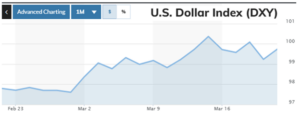
Source: Marketwatch
Another important consideration is that no two events are the same. The investment world went into this conflict with Iran with gold trading at all time highs, up 229% in a little over 3 years. Gold is, at least for now, viewed as a source of liquidity for countries impacted by higher oil prices or increased defense budgets. In that vein, the Governor of the Polish National Bank earlier this month floated the idea of taking unrealized profits in their gold holdings to fund defense spending. Poland has been one of the biggest purchasers of gold in recent years. It’s possible the sorts of things that have been pushing gold prices higher these last few years (deficit spending, central bank gold buying) reassert themselves when the Iran situation calms down, but until then gold remains a key source of liquidity for many investors.
Are we headed for recession? The answer to this, we think, is “not yet.” Nowhere in the data do we see flashing alarm bells for recession. The jobs market, though not going gangbusters, hasn’t deteriorated. This week’s jobless claims number was at just 205,000, far below levels at which economists begin to worry. Other data on things like industrial production and manufacturing and trade sales show things holding steady. Looking to markets, strength in transportation stocks is another indicator that tells us things are holding up. A large transportation company reported strong 4th quarter earnings this week and raised guidance for 2026, despite the conflict with Iran. These aren’t things you tend to see in or around a recession.
We think the environment remains uncertain, but hopefully this “mailbag edition” of WealthNotes helped answer some of the questions that seem to be on the mind of most investors. If there is a question on your mind and you don’t want to wait for the next mailbag, never hesitate to reach out, we’re always available for discussion.

Written by Alex Durbin, CFA, Partner & Chief Investment Officer