
Why Real Assets?
April 24, 2026
To Inform:
The Joseph Group hosted a “Portfolios at Your Place” Zoom call for clients and friends of the firm earlier this week in which CEO Travis Upton and I did a deep dive on the Provision strategy we have the privilege of managing for many clients. We walked through the five key asset classes we use to construct the strategy and shared how each is useful for reaching the objectives of current income and low principal volatility. A key in this process is our use of Real Asset funds in client portfolios.
What are real assets? I like to say it’s stuff (commodities), things used to move that stuff (infrastructure – think railroads, pipelines, utilities) and places where that stuff gets sold or consumed (real estate). The table below from Cohen and Steers, a real asset-focused company, gives a more detailed explanation of this asset class.
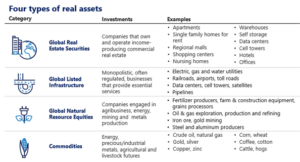
Source: Cohen & Steers
The “why” behind real assets is every bit as important as the “what”. Our decision to add these types of investments to client portfolios stems from research that shows these asset classes have different risk drivers than traditional stocks, for example. One risk driver is inflation. The table below shows how real assets have performed during periods of unexpected inflation over the last 35 years. Each type has outperformed global stocks by a wide margin, and bonds by an even greater margin.
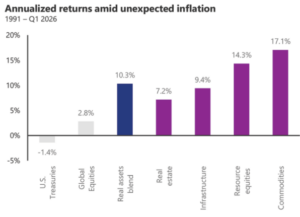
Source: Cohen & Steers
We saw this sort of performance in the first quarter of 2026, a quarter very much defined by “unexpected inflation.” The chart below shows performance of indexes that track commodities, real estate, and infrastructure during the 1st quarter, as well as the return of the S&P 500. In a quarter when the S&P 500 was down nearly 5%, an equal-weighted blend of the three real asset indexes returned just over 11%.

Source: YCharts
The performance diversification benefits of real assets are a powerful tool, but they also generate meaningful levels of income. As a group, these asset classes yield somewhere around 3% as the types of companies found in these categories tend to have predictable cash flows that are paid out to investors.
We hope this short primer on real assets gives you a better understanding of not only the asset class, but why we think they are so important in constructing diversified investment portfolios that seek to deliver on an objective. In the case of our Provision strategy, an asset class that provides income, can “zig” when the rest of the market is “zagging,” and can provide a hedge against unexpected inflation is a powerful tool in helping the clients we have the privilege of serving reach their long-term objectives.

Written by Alex Durbin, CFA, Partner and Chief Investment Officer